
October’s biggest banking and fintech news, plus what’s new at Bretton.
Welcome to the first issue of The Bretton Vault, our monthly recap of what’s new in the world of banking and Bretton. We’ll start with October’s biggest banking headlines, then catch you up on everything we launched and shipped this month.
Banking and fintech headlines
Bank of America and American Express pay $1.55B in AML penalties
On October 13, FinCEN fined Bank of America $1.2 billion for failing to report more than $5 billion in suspicious transactions and leaving alerts uninvestigated. Five days earlier, the OCC and the Fed fined American Express $350 million after about $13 billion in suspected trade-based money laundering went unreported over more than a decade. (Treasury, Banking Dive)
Our CEO, Will Lawrence, told Global Finance the fine is the easy part: "What's much harder is operating once regulators lose confidence in the institution's ability to manage risk." Read his full take.
Binance loses $6.3B in the largest crypto hack on record
On October 29, hackers drained about $6.3 billion from Binance wallets, most of it in roughly 20 minutes. Blockchain analytics firm TRM Labs attributes the attack to North Korea. Within hours, stablecoin issuers including Tether and Circle froze about $2.7 billion. (TRM Labs, Bloomberg)
AI agents start moving real money
On October 21, Stripe launched Treasury for agents, which lets businesses use AI agents to check balances, pay invoices and move funds, with a person approving money movement wherever the business requires it. The same week, Visa, BILL and Billtrust announced a live pilot in which an AI agent pays supplier invoices that the buyer has already approved, without anyone logging into a supplier portal. (Stripe, Accounting Today)
Kaufman Rossin independently validated Bretton’s agents
This month, Kaufman Rossin, one of the top 50 accounting and advisory firms in the U.S., completed an independent model validation of Bretton's KYC, AML and sanctions agents.
The review examined the governance, outputs and conceptual soundness of our platform, including model accuracy and stability, explainability and decision traceability, change management, ongoing monitoring and model risk governance.
In his assessment, Principal Jason Chorlins highlighted how our agents combine "LLM-based investigative reasoning with deterministic rule-based logic," with structured outputs and mandatory human review before any final decision. Read the announcement.
What we shipped: four updates to the Bretton platform
This month's updates help teams disposition alerts faster, with clearer evidence behind each decision.
Agent Artifacts: your format, on every case
Most reviews end in a document, like a partner bank's EDD questionnaire, a referral form or a closure letter. Bretton agents now fill your institution's own Word, PDF, Excel or CSV templates from the case findings, keeping your layout and marking any question the review left open. A U.S. bank with more than $200 billion in assets already uses it to prepare requests for information in its payments EDD reviews. Read the blog
Screening alert reviews resolve faster, with fewer wrongly cleared
Screening alert reviews now run on an upgraded foundation, with each review step matched to the reasoning it needs. Alerts resolve faster, and fewer that should reach an analyst are cleared automatically. It applies to all sanctions, PEP and adverse media alerts, with nothing to turn on.
QC scorecards now cite evidence for every issue
Bretton's AI pre-fill for quality control (QC) scorecards used to suggest a score without showing where the problems were. It now reviews the full case and your team's past reviews of the same scorecard, then lists specific problems first, each backed by a quote from the case.
Workbench handles file-heavy work faster
Workbench, the AI workspace where analysts work each case alongside our agents, now runs on a more capable foundation. Analysts get faster, more accurate answers on investigations heavy with documents and calculations.
You can find every release, with full details, in The Bretton Ledger, our public changelog.
The Standard: a magazine for the people who run America's banks
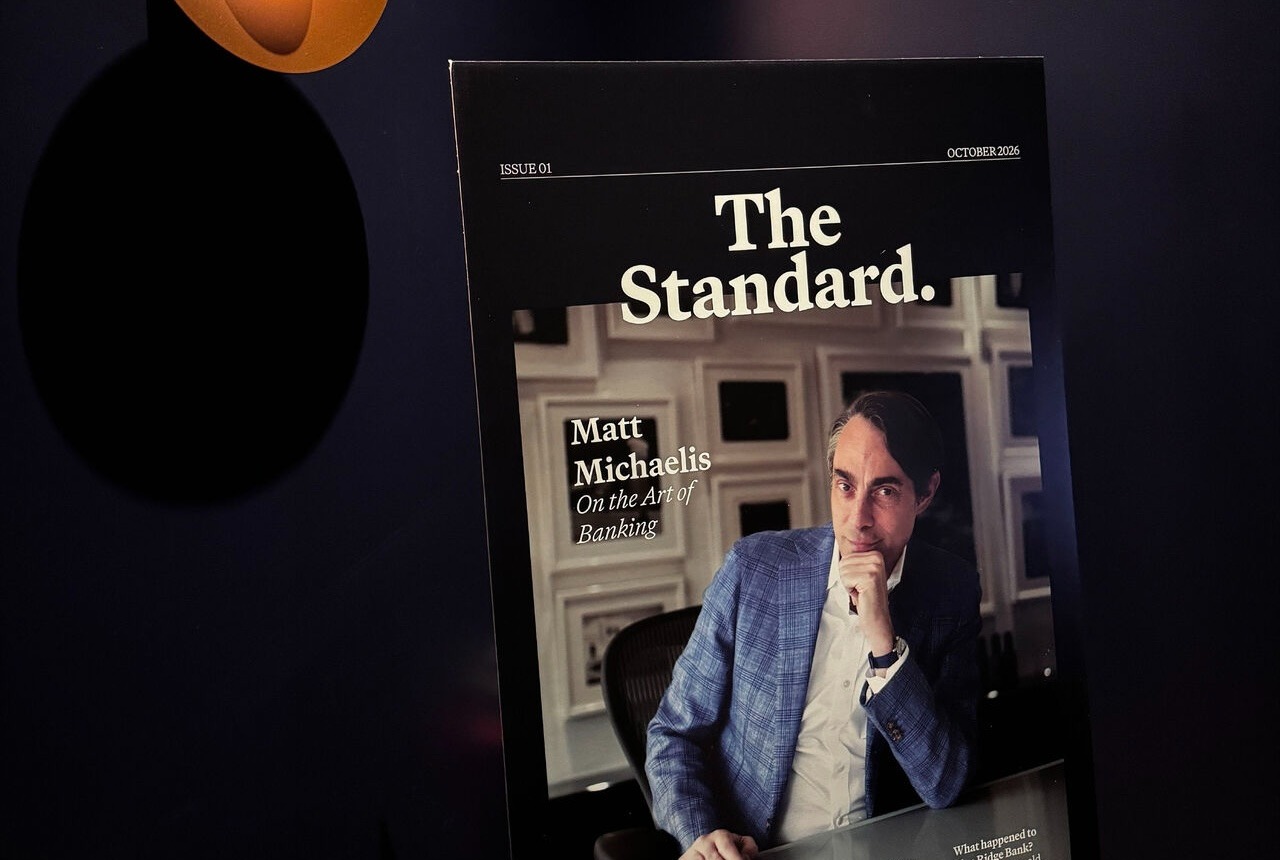
After months of planning, photo shoots and editing, we launched The Standard at Money20/20 in Las Vegas. It's a quarterly print magazine about the people running America's banks, many of them far from the money centers, whose work rarely gets covered.
A note from our founder
"In 1873, Walter Bagehot wrote that money will not manage itself. It still doesn't. It is managed by people, in institutions, and most of their stories never get told."
"We started The Standard because the people doing the work of banking deserve coverage held to the same standard as that work. We hope you enjoy it."
Will Lawrence, Co-Founder and CEO, Bretton AI
Interested in a copy? Request a print and we'll mail one to you. For the rest of our week in Las Vegas, read our Money20/20 recap.
In the press
- CB Insights: CB Insights named us to its 2026 Fintech 100, its annual list of the most promising fintech companies.
- PYMNTS: First Internet Bank cut SBA compliance review times by 87% with Bretton, freeing up about 24,300 hours a year to grow its lending.
- Global Finance: Our CEO Will Lawrence on why Bank of America's $1.2B penalty is a warning for the rest of Wall Street.
- S&P Global Market Intelligence: Why banks are starting to track and disclose their gains from AI, with Will on where the returns show up.
Until next month
That's a wrap for October. For more before the next issue, here's what our team has been writing about:
- Deploying agents inside the biggest, most secure global banks: how global banks run our agents on their own infrastructure, with control of their data, approved vendors and model changes.
- Regulators asked us to focus on risk. Here's the playbook: Rick Shooman, our Head of Managed Services, on how banks can fund FinCEN's push toward high-risk work by cutting the cost of the routine.
- Agent in a day: a behind-the-scenes look at how we turn a bank's SOPs and past cases into a working agent in one day.
Thanks for reading. We'll be back at the end of November. In the meantime, follow us on LinkedIn, or catch us on X at @brettonai. And if you'd like to see how Bretton handles your own alerts, we'd be glad to show you.
AI agents for the financial back office
Bretton builds AI agents for the back office of banks and financial institutions — compliance review, investigations and the operational work that still scales with headcount. Payward, the parent company of Kraken, uses Bretton to clear high-risk cases with full quality control instead of hiring against the backlog.