Bretton AI agents now fill out your institution's own documents.
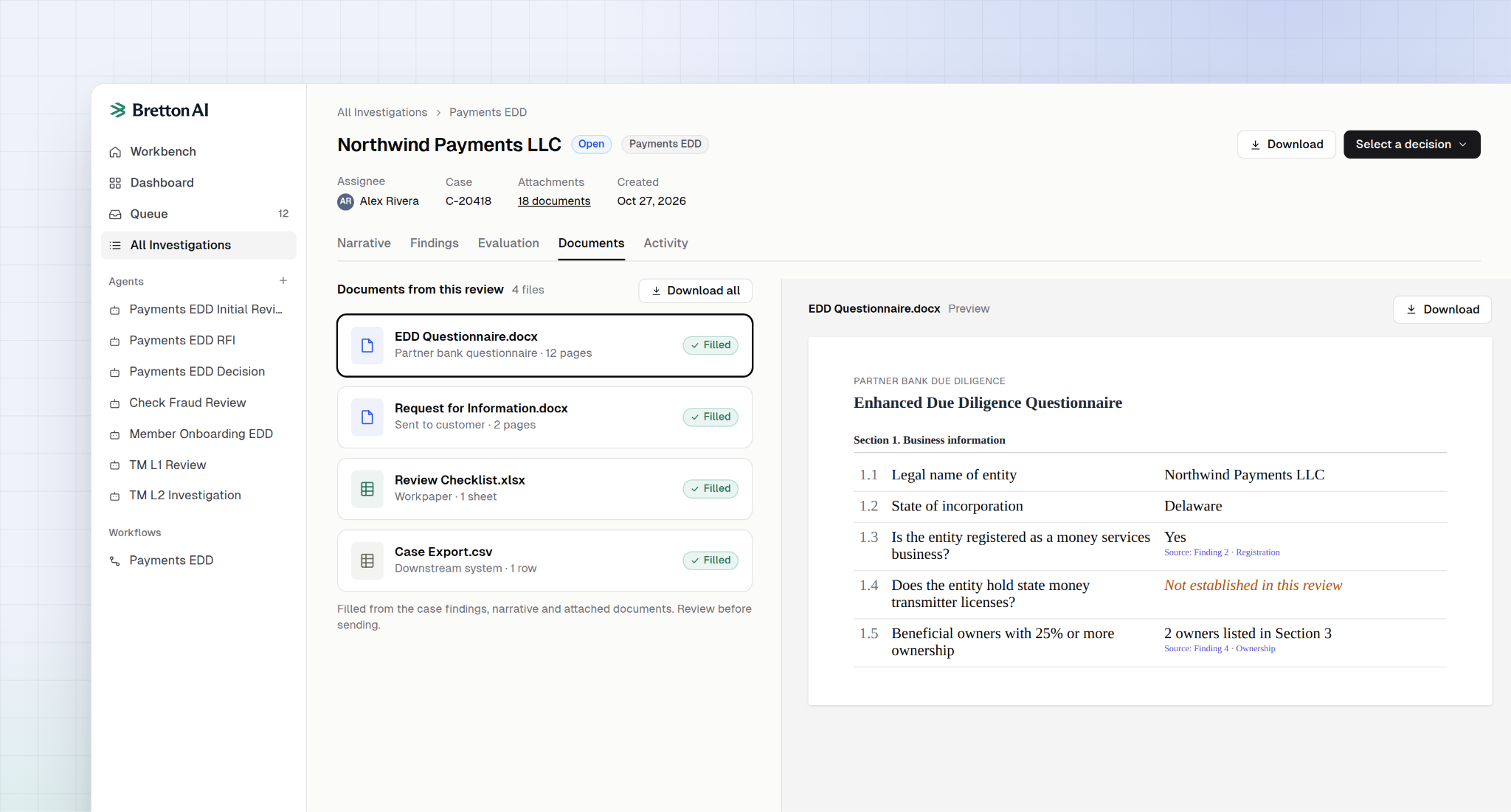
Bretton AI agents can now complete the forms your team fills out after every review. Upload a blank Word questionnaire, PDF form, Excel workpaper or CSV. When the agent finishes a case, it fills a copy with what the review found and attaches the completed file to the case.
Most reviews end in a document: a partner bank's EDD questionnaire, a referral form, a closure letter, an examiner workpaper. Before Agent Artifacts, analysts had to finish the investigation, then copy the results into each form by hand. Agent Artifacts gives that work to the agent.
What's new
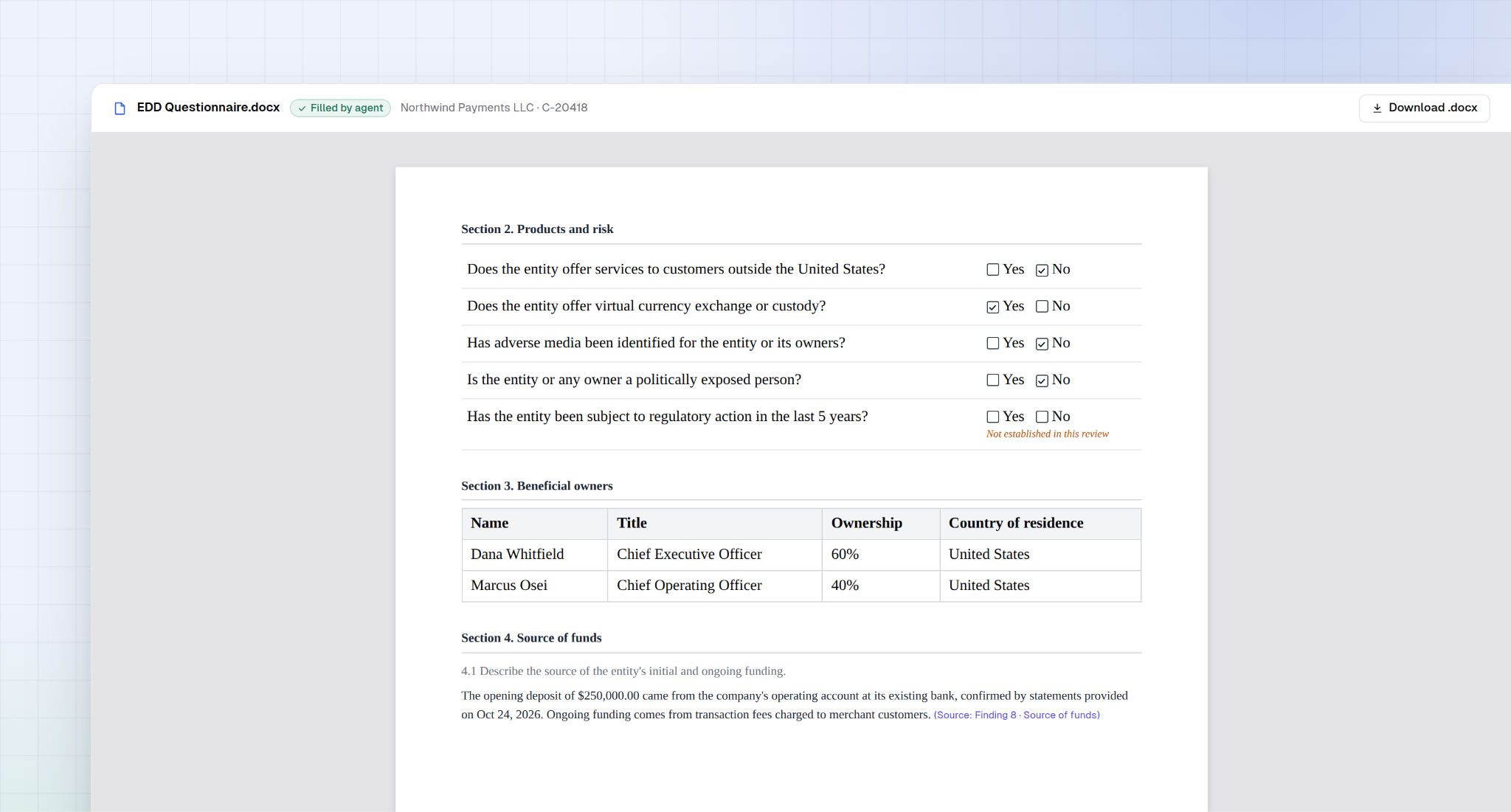
- Your format stays intact. The agent fills a copy of your file. Logos, fonts, layout and fixed text stay exactly as you designed them.
- Every answer comes from the case. The agent copies answers from the case's findings, narrative, case data and attached documents. It never estimates, calculates totals or answers from general knowledge. When the review leaves a question open, the agent writes the fallback text you choose, such as "Not established in this review," so reviewers can see which questions still need an answer from the customer.
- The same case produces the same form. Fill rules set the source for each question, the format for dates and amounts, and the evidence that ticks Yes or No.
- Documents follow outcomes. Attach a referral form to the escalation outcome, a closure letter to the close outcome, or a checklist to every case. A condition such as "only when the primary entity is a company" limits a document to the cases it applies to.
- Cases complete regardless. If a document fails to generate, the case still finishes and the document shows the error.
How a $200 billion-plus bank uses Agent Artifacts
A U.S. bank with more than $200 billion in assets uses Agent Artifacts in its payments EDD reviews. When a review needs more information from the customer, the agent fills the bank's own request for information document from the case findings. An analyst checks the filled document and sends it, without retyping anything from the case.
Supported formats
Agent Artifacts supports four file types up to 50 MB. The filled file always matches the template's format.
- Word (.docx): questionnaires, memos, referral forms and letters. The agent fills blanks, table cells, checkboxes and dropdowns, and adds table rows when a list runs long.
- Excel (.xlsx): workpapers, checklists and schedules. The agent fills answer cells and rows and leaves formulas in place, so totals recalculate when the file opens.
- PDF: fillable and flat forms. Fillable fields stay editable, and existing signatures are preserved.
- CSV: data exports and bulk-upload files. The agent keeps the template's delimiter and encoding so the receiving system can read the file.
How it works
- The agent investigates the case and reaches an outcome.
- The agent fills each document assigned to that outcome, plus any document set to run on every case.
- The filled files appear on the case's Documents tab, where your team can preview them, download them one at a time or download all of them as a zip.
Getting started
The Bretton AI team sets up each document with you. We compare the form against what the agent investigates, since the agent can answer only the questions its checks research. We then write the fill rules, confirm the decisions that belong to your team, such as rounding or how a clean adverse media result answers a litigation question, and preview the filled document on past cases before it goes live.
Agent Artifacts is available for all customers. Contact your Bretton AI deployment strategist if you have any questions.
AI agents for the financial back office
Bretton builds AI agents for the back office of banks and financial institutions — compliance review, investigations and the operational work that still scales with headcount. Payward, the parent company of Kraken, uses Bretton to clear high-risk cases with full quality control instead of hiring against the backlog.